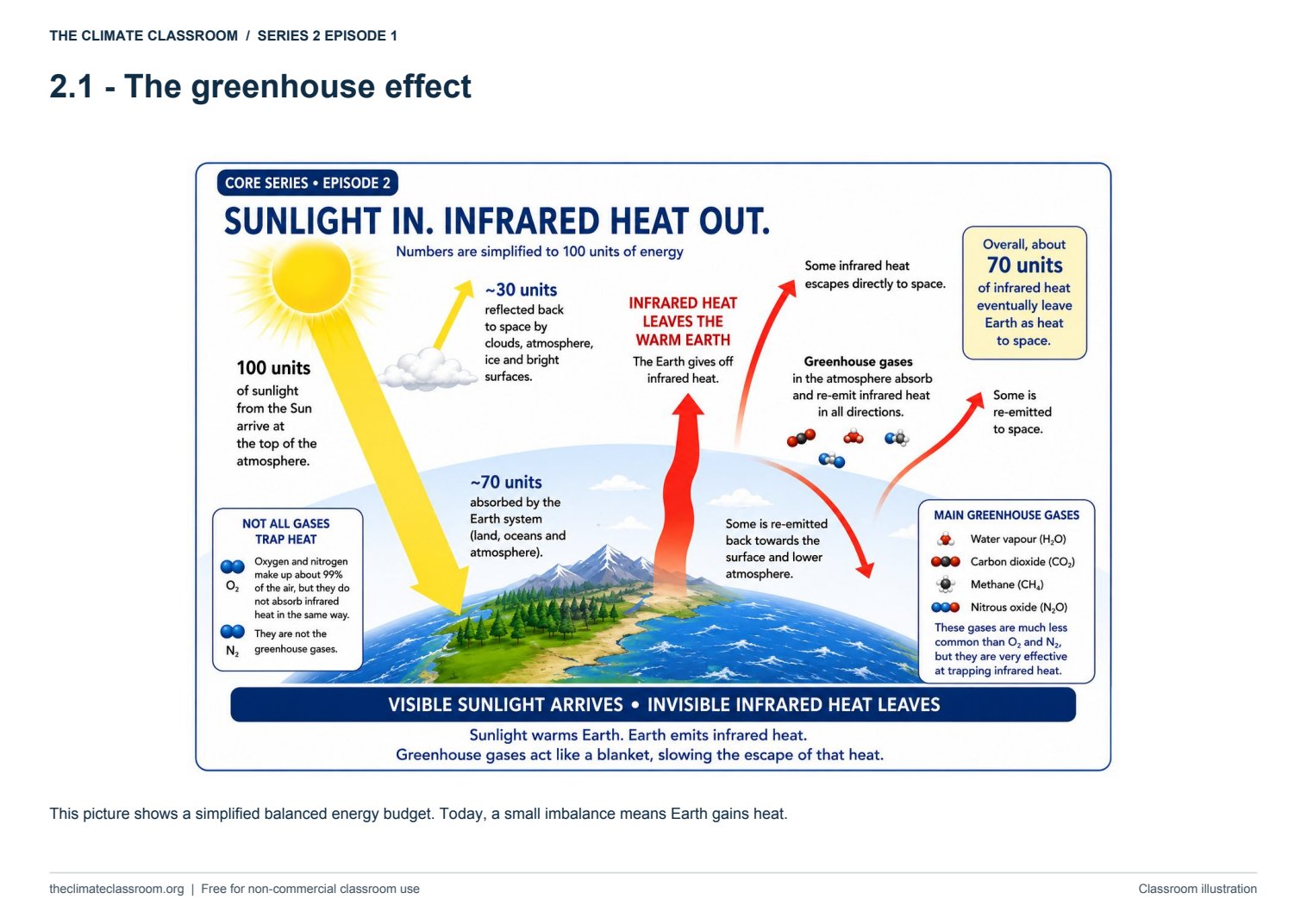
Illustration 2.1
The greenhouse effect
This picture shows a simplified balanced energy budget. Today, a small imbalance means Earth gains heat.
Download printable sheetDownload imageSeries 2 · Episode 1 · Video podcast · About 12 minutes
Explore Earth’s energy balance, what net zero CO₂ means, and why every cut in emissions matters. Use the printable teaching resources below alongside the episode.
Available now in video and audio.
Free Series 2 · Episode 1 classroom pack
3 printable illustrations, a six-question multiple-choice quiz and a separate teacher answer sheet. The complete 5-page PDF uses landscape A4 for illustrations and portrait A4 for the quiz and answers.
For pupils, print the quiz separately. The last page of the complete pack contains answers. Print at actual size or fit to page, with automatic orientation.
Illustration 2.1
This picture shows a simplified balanced energy budget. Today, a small imbalance means Earth gains heat.
Download printable sheetDownload image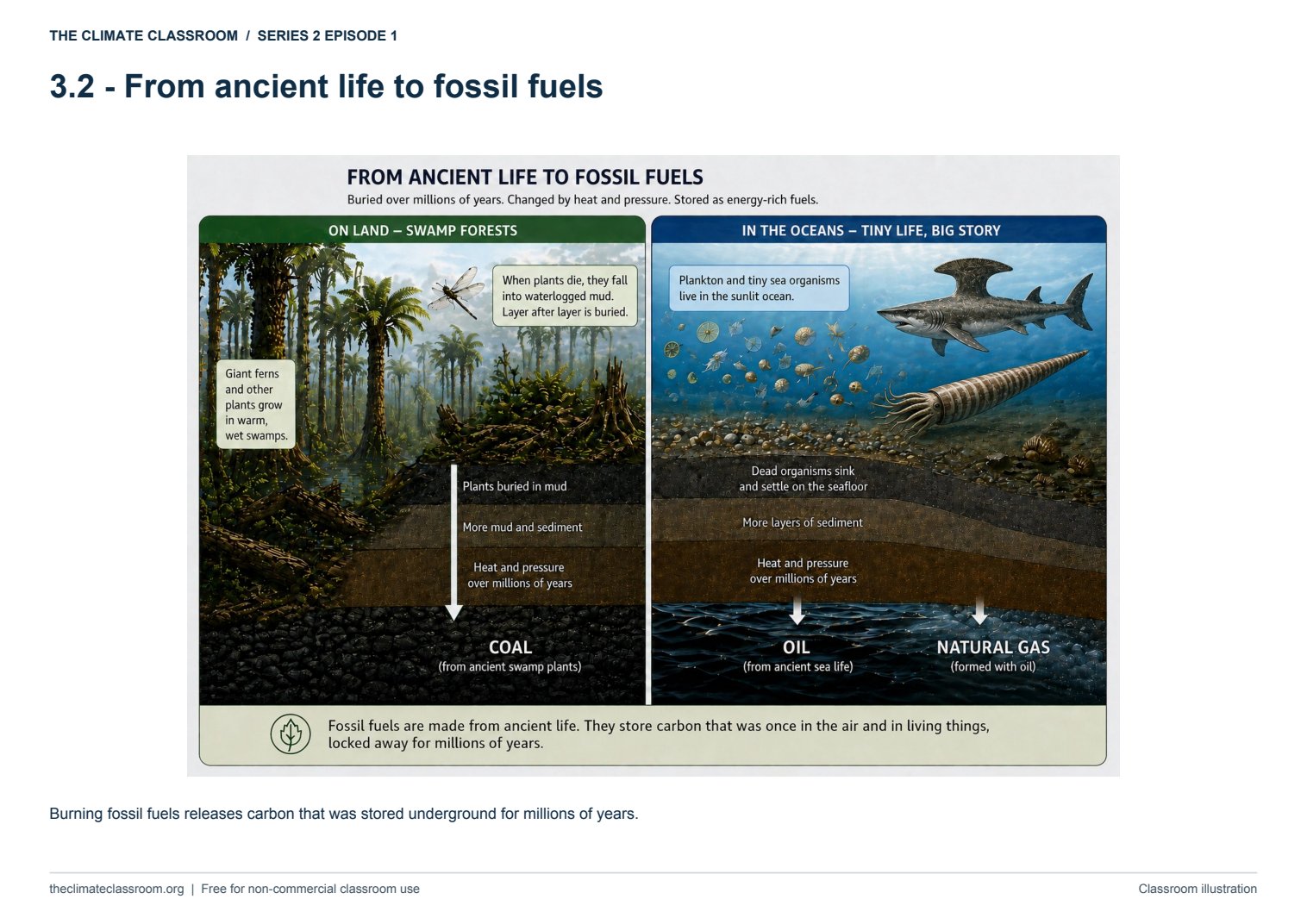
Illustration 3.2
Burning fossil fuels releases carbon that was stored underground for millions of years.
Download printable sheetDownload image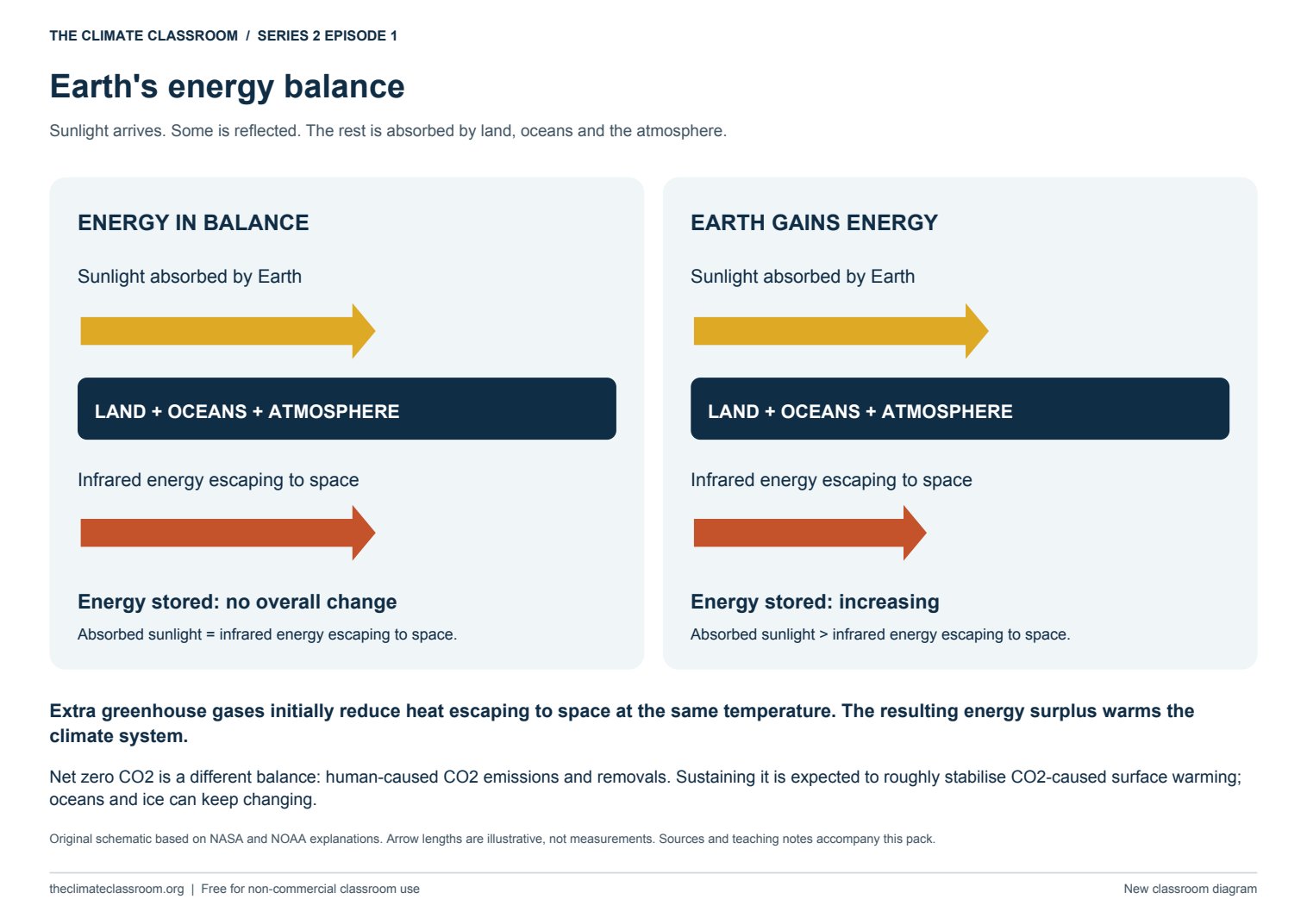
New classroom diagram
Compare the two cases. What must happen to Earth's energy store when more energy is absorbed than escapes?
Download printable sheetDownload imageFree to download and print for non-commercial classroom use. Sources and artwork credits are included in the teacher guidance. The energy-balance diagram is original artwork based on NASA and NOAA explanations; no agency artwork or logos are reproduced.
Series 2 — What Happens Next? builds on Series 1 — Core Climate Science to explore practical questions, beginning with limiting warming. Its eight video podcasts can be used for teacher-led classroom viewing or listening or explored at home with a parent or carer.
Building on Core Episodes 1 and 2, this episode explores Earth’s energy balance and uses a jar of marbles to distinguish CO₂ emissions from the amount already in the atmosphere. It explains why cutting emissions is essential, what global net zero CO₂ means, and why every tonne avoided matters. Glaciers, oceans and sea level can keep changing after surface warming levels off. One Bright Thing looks at the UK’s move away from coal-fired electricity.
Learning objective: Distinguish emissions, atmospheric concentration and net zero; explain why surface temperature can stabilise while other climate impacts continue.
Keywords: energy balance, infrared radiation, emissions, atmospheric concentration, carbon sinks, net zero, glaciers, sea level.
Natural carbon uptake and human-caused removals are different parts of the explanation: net zero balances human-caused emissions with human-caused removals. Natural sinks can continue absorbing CO₂ afterwards. Approximately stable surface temperature does not mean immediate equilibrium throughout the climate system.
The downloadable teacher sheet includes answers, further guidance and links to NASA, NOAA and IPCC sources.
Two illustrated lessons on YouTube and Spotify lead into this episode:
Both Series 1 episode pages include YouTube and Spotify links and printable classroom packs.