If you remember one thing:
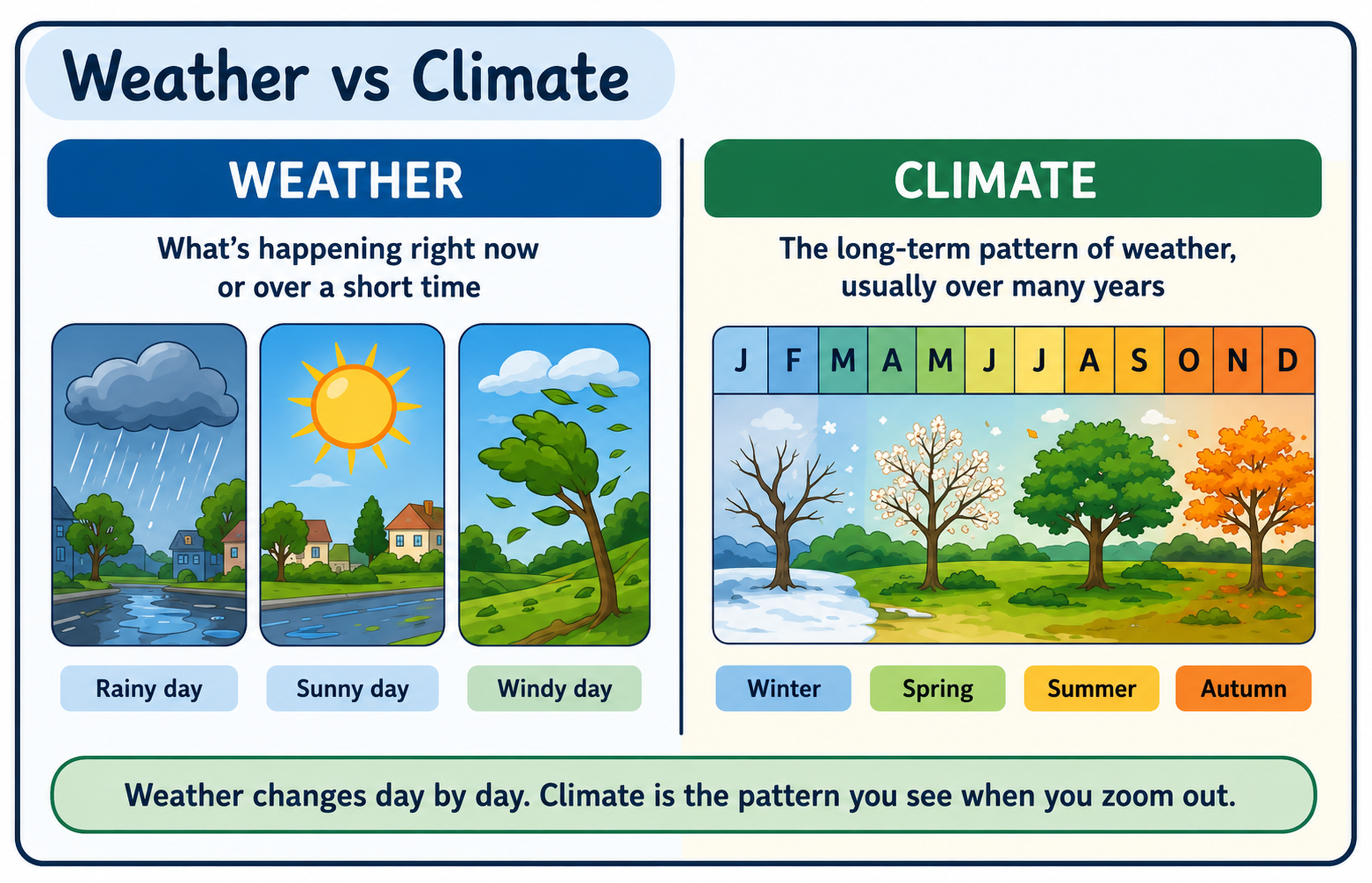
“Weather is what you get. Climate is what you expect.”
If today’s forecast says “heavy rain”, does that mean the climate has changed?
This episode clears up the most common mix-up in climate conversations - calmly, simply, and without jargon.
🐾 Belle’s Question
“What’s the difference between weather and climate - aren’t they the same thing?”
🌍 The big idea (explained simply)
Weather jumps around day to day. Climate is the background pattern you see when you zoom out over many years. One hot day is weather; a long-term shift in averages - and the chances of extremes - is climate change.
🌱 One Bright Thing
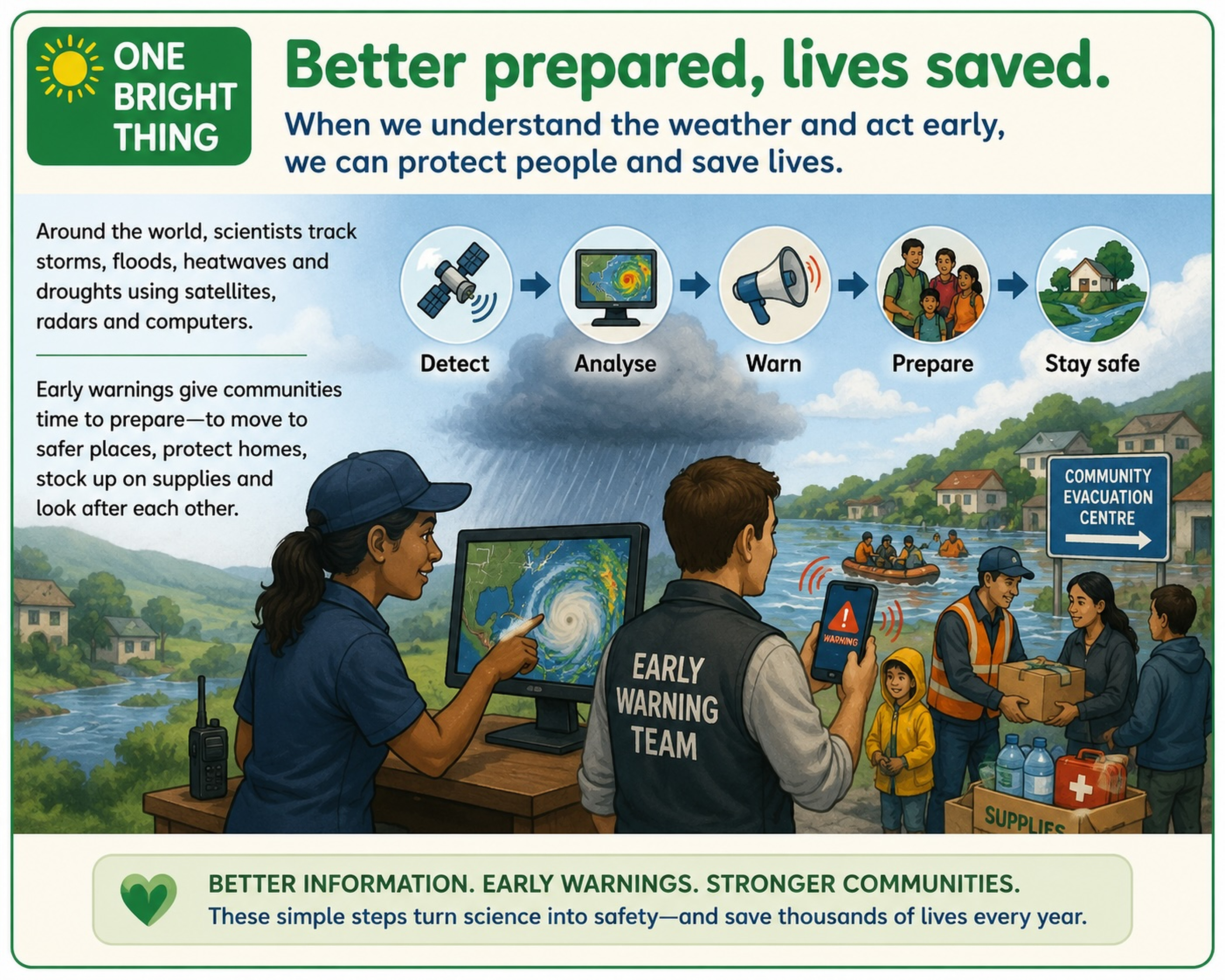
Better measurement saves lives. In Ahmedabad, India, improved heat warnings helped hospitals, schools, and communities prepare - with researchers estimating around 2,380 deaths avoided in 2014-2015 compared with a 2007-2010 baseline.
🏫 Quick quiz (for families & classrooms)
• Weather is: today and this week - or decades?
• Climate is: tomorrow’s forecast - or the long-term pattern?
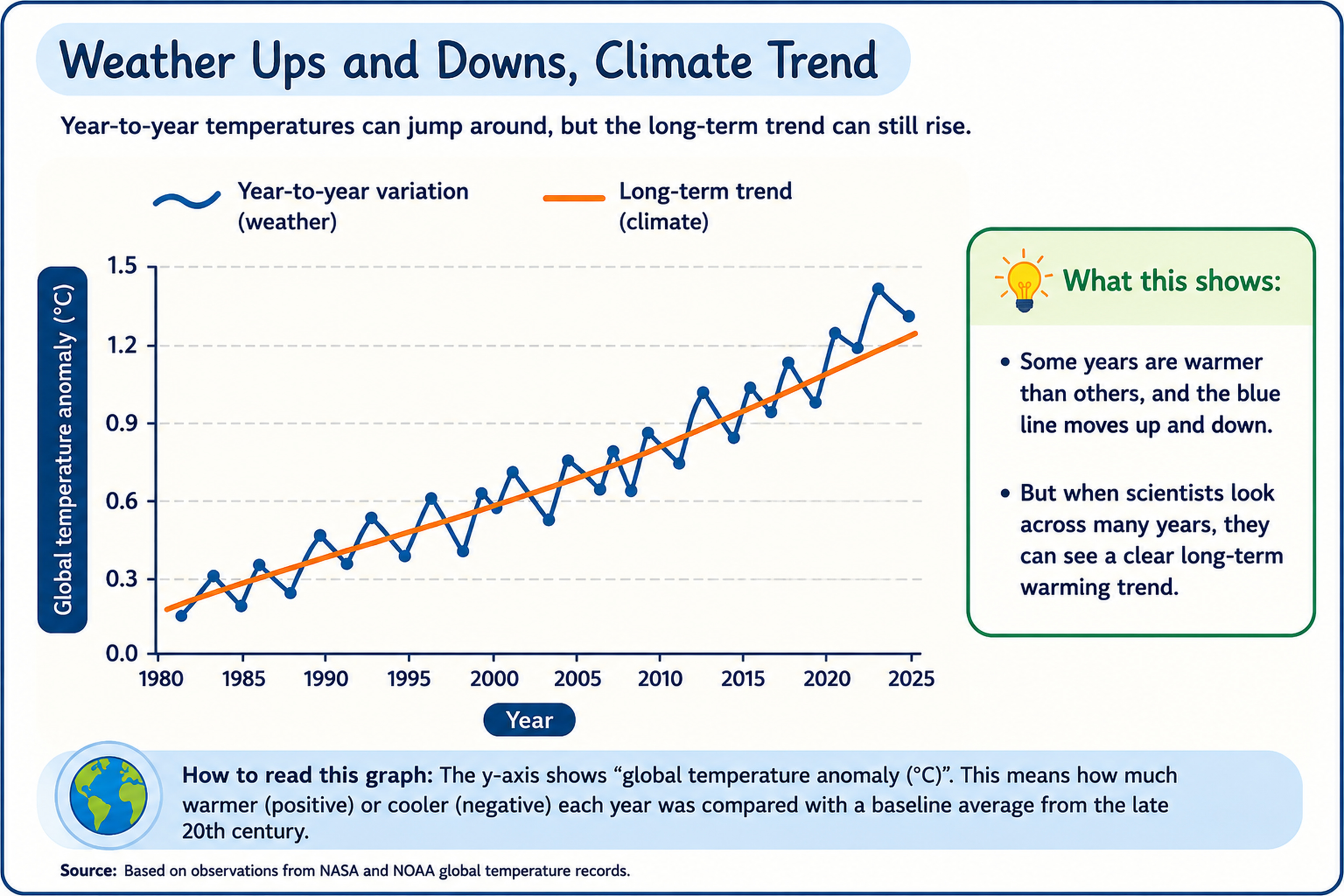
• To spot real climate change, do scientists look at one unusual day - or many years of data?
🔔 Follow & Ask Belle
If this helped, follow The Climate Classroom on Spotify or Apple Podcasts - it means the next school-run episode arrives automatically.
Got a question for Belle? Send it on Spotify, or at https://www.theclimateclassroom.org - with “the” at the start.
—– READ MORE / FULL NOTES —–
🎧 In this episode
• Weather means today and this week; climate means the long-term pattern (usually decades)
• The simplest line: Weather is what you get. Climate is what you expect.
• Why scientists often use about 30 years to spot real climate trends
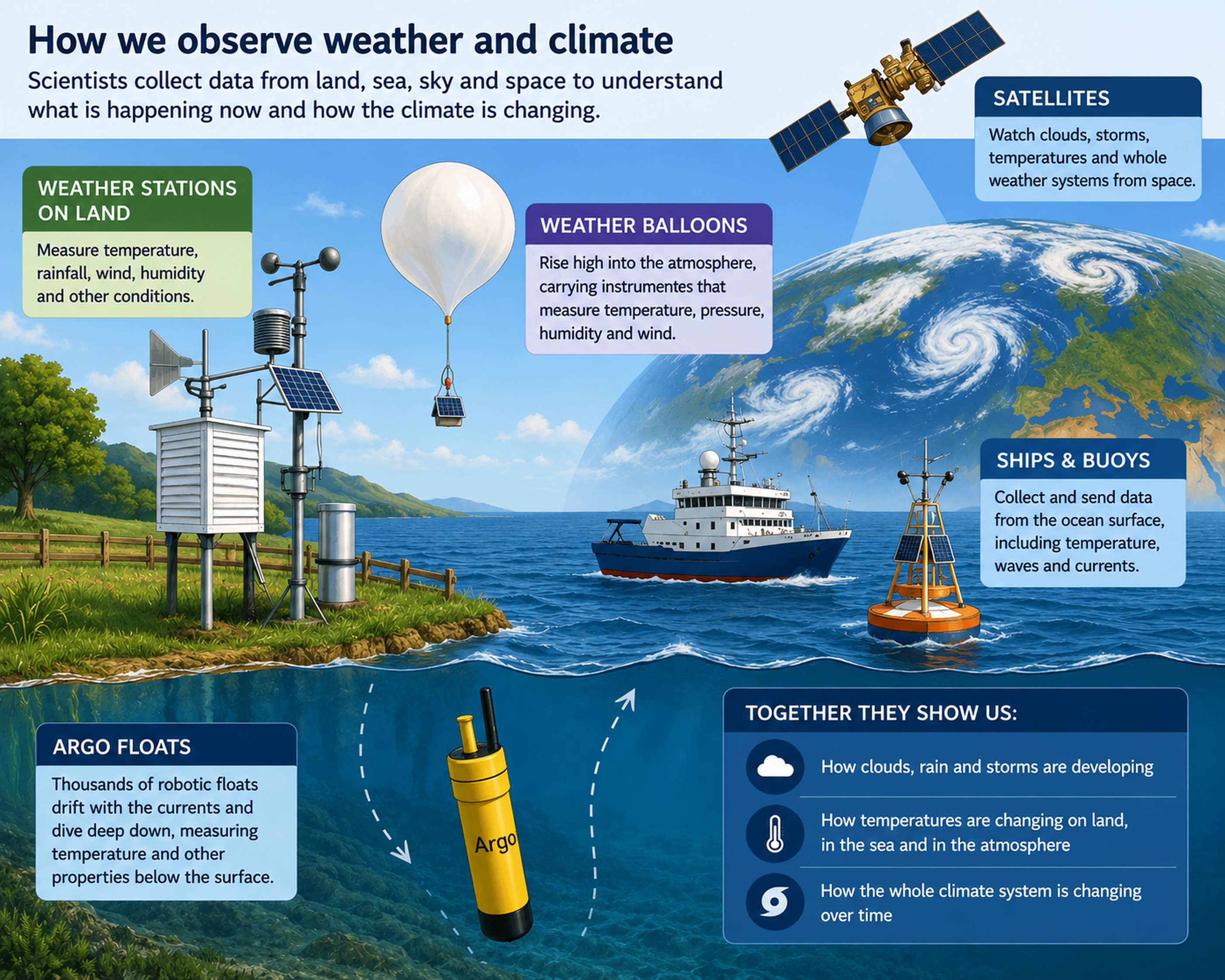
• How Earth is measured like a giant experiment: stations, ocean floats, balloons, satellites
🏫 For families & classrooms (discussion prompts)
• If weather jumps around, what kind of evidence would convince you the climate is changing?
• Which analogy works best - football match vs season or page vs book - and why?
📚 Sources & further reading (with references)
Context (WMO)
• WMO press release confirming 2024 about 1.55 C above 1850-1900:
https://public.wmo.int/news/media-centre/wmo-confirms-2024-warmest-year-record-about-155degc-above-pre-industrial-level
• WMO State of the Global Climate 2024 publication page (report hub):
https://public.wmo.int/publication-series/state-of-global-climate-2024
Argo floats (upper-ocean measurements)
• NOAA AOML Argo overview:
https://www.aoml.noaa.gov/proj/argo/
Weather balloons / radiosondes (upper-air measurements)
• NOAA NCEI IGRA:
https://www.ncei.noaa.gov/products/weather-balloon/integrated-global-radiosonde-archive
• WMO Global Observing System:
https://wmo.int/activities/global-observing-system-gos/global-observing-system-gos
Satellites (weather & Earth observation)
• NOAA / NESDIS Currently flying:
https://www.nesdis.noaa.gov/our-satellites/currently-flying
• EUMETSAT:
https://www.eumetsat.int/about-eumetsat
Ahmedabad Heat Action Plan (One Bright Thing evidence)
• Peer-reviewed evaluation (open access):
https://pmc.ncbi.nlm.nih.gov/articles/PMC6236972/
Teacher notes
Learning objective: Distinguish a short-term weather observation from a long-term climate pattern.
Keywords: weather, climate, averages, measurements, trends.
Activity: Sort statements such as “It rained today” and “Winters have become warmer over many decades” into weather and climate. Ask what evidence each statement needs.
Quiz answers: Today and this week; the long-term pattern; many years of data.
Teaching point: One unusual day cannot establish a climate trend. Use the climate-trend illustration to discuss patterns despite year-to-year variation.